
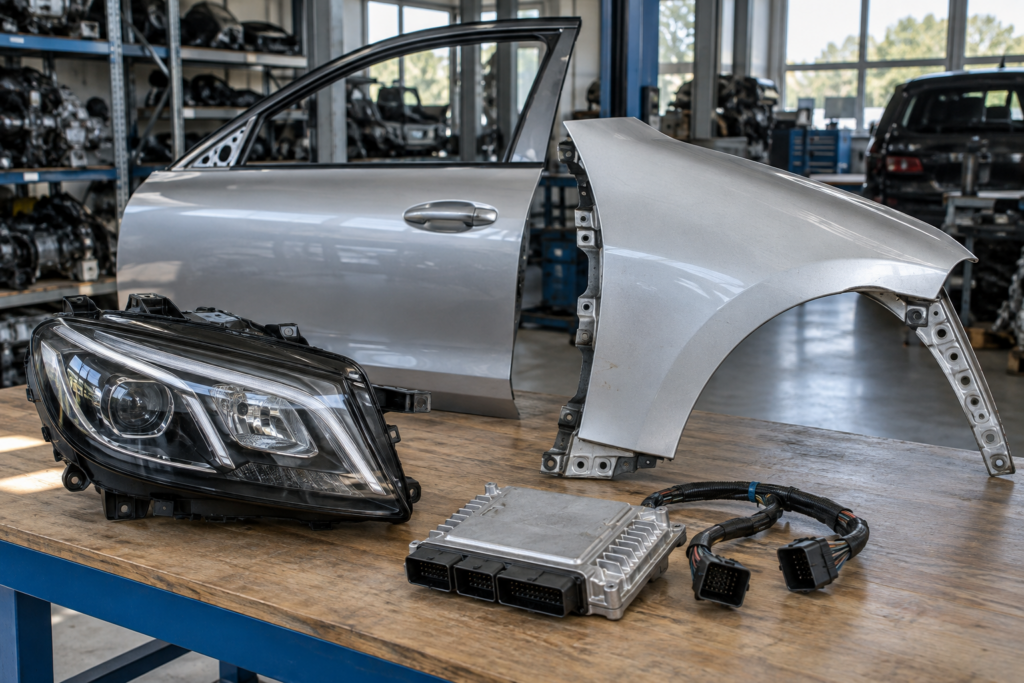
The passenger window on a 2001 CLK320 stops halfway. It won’t budge after that. The switch still clicks, the fuse is fine, and a scan points to the front right door control module. Instead of paying for a new unit from the dealer, the owner can look through a catalog of used mercedes parts and find the original module for the 98–03 W208 under part number 2088203226.
If you own an aging CLK, S-Class or SL, you’ve probably been here. More than once. The engines on these cars can keep going for a very long time. Switches, modules, trim and body panels age on their own clock, though, and plenty of new replacements are expensive or just aren’t made anymore. Mercedes used parts pulled from donor cars fill that gap, as long as each one was built for your platform.
Why used Mercedes parts make sense for aging models
A Mercedes from the 1990s or early 2000s was designed around components the factory quit making once the model left production. So what do you do? Among used Mercedes parts, an original component comes off the same production line as the one that failed. Its connectors, mounting points and dimensions are exactly what the car expects.
When you’re shopping for used Mercedes Benz parts, range matters as much as price. The California Auto Store Mercedes collection lists 8,214 products across 685 pages. It covers C-Class, E-Class, S-Class and SUV models, plus AMG versions. With that many listings, tracking down a specific module for a specific year is realistic.
Not everything belongs on a second-hand list, though. Buy brake pads, filters, belts and rubber seals new. You can’t really tell how much life they’ve got left from a photo.
Parts that rarely wear out in normal use are another story. Three groups stand out:
- Bumper covers and body panels. They crack in minor knocks, but off a donor car they come with the factory mounting points and fit intact.
- Control modules for doors, seats and fuses. These tend to fail one at a time, and you can swap one without touching the rest of the wiring.
- Instrument clusters, mirrors, switches and dashboard trim, where an original piece matches the rest of the cabin in both look and connection.
Reading chassis codes before buying Mercedes-Benz used parts
Badges like CLK320 or S55 tell you the model and engine. Fitment, though, comes down to the chassis code. The letter gives the body style. The three digits identify the platform. Mercedes uses W for saloons, C for coupes, R for roadsters and A for cabriolets, so the R129 is the SL roadster built from 1989 to 2001.
Sellers often slap W on the whole family. That’s why the CLK coupe shows up in listings as W208 even though its factory code is C208. Don’t let it throw you. What counts is that the three digits match your car. Before ordering any Mercedes Benz used parts, look up the chassis code on the vehicle data card, in the service booklet or with a VIN decoder.
Catalog titles pack all of this into a fixed order. Take the listing “98-03 Mercedes W208 CLK320 CLK430 Front Right Door Control Module 2088203226 OEM.” In a single line it names the years, chassis, models, position, part and number.
Each piece of that title answers its own question:
- The year range 98–03 shows which model years got the part. Mercedes often changed components partway through a production run.
- W208 is the chassis code. Don’t assume the part fits a W210 E-Class, even where the two cars share an engine.
- Front right is the position. On a left-hand-drive car sold in the US, that’s the passenger door, not the driver’s.
- The ten digits 2088203226 are the Mercedes part number. Match them to the label on your old unit. It’s the most reliable check there is.
The digits hold one more clue. On many Mercedes components the first three digits repeat the platform: 208 points to the CLK and 220 to the S-Class, as in the W220 bumper cover 2208808070. Numbers starting with 000, like the fuse relay junction box 0005400072, usually belong to parts shared across model lines. That’s why that box is listed for the CLK430, CLK55 AMG and E320.
Body panels and electronics in used parts Mercedes listings
In most used parts Mercedes catalogs, body panels show the savings of buying used most clearly. They also punish careless ordering. The California Auto Store collection has front bumper cover assemblies for the 01–04 R170 SLK320 and SLK230, the 00–02 W210 E320, E430 and E55 AMG, and the 03–06 W220 S55 AMG saloon.
Read the model list in each title carefully. The W210 cover is listed for three E-Class versions. The W220 cover names only the S55 AMG, so if you drive a standard S500, don’t assume it fits. The W210 and SLK listings also state a color, silver and black respectively. Different from your paint? Budget for a respray.
Electronic modules are small and light, and they’re seldom damaged when they come out. The front left seat control module 2118208585 is listed for the 03–12 W219 E500 and CLS500. Why one unit for both names? It’s the 211 prefix. The W219 CLS was built on the W211 E-Class platform, so the two share a lot of their electronics.
Year ranges can differ between parts on the same chassis, too. The W208 door module covers 98–03 cars. The left door mirror is listed for 00–03 only. Own a 1999 CLK? Don’t assume that mirror fits.
Instrument clusters need extra thought. The catalog lists one for the 93–95 R129 SL500 and 500SL. A replacement cluster comes with its own odometer reading, though, so check your local rules on recording a mileage change before you fit it.
Ordering used Mercedes-Benz parts without guesswork
Start with the part you’re replacing. Pull it if you can and photograph the label. Mercedes prints the number on most modules and many panels, often with a leading letter A that catalog titles drop. So A2088203226 on the old unit and 2088203226 in a listing are the same part.
Next, compare your chassis code and model year with the year range and model list in the title. Number matches but your exact model isn’t on the list? Ask the seller to confirm fitment before you order.
The store has a guide called “How to Find Your Part Number,” plus pages on shipping, returns and order tracking. Read them before a big bumper cover order. You’ll know what to expect on delivery, and what happens if the part doesn’t fit.
Think about the install as well. Some Mercedes control modules need to be coded to the car with a diagnostic tool after fitting. Ask a shop that knows your model whether the replacement will work right away.
Before you search, write down four things: the chassis code, the model year, the part’s position and the number from the old unit. With those in hand, Mercedes used parts can be matched to your car in a few minutes of reading titles. And the window on that CLK320 goes back up without a dealer invoice.