
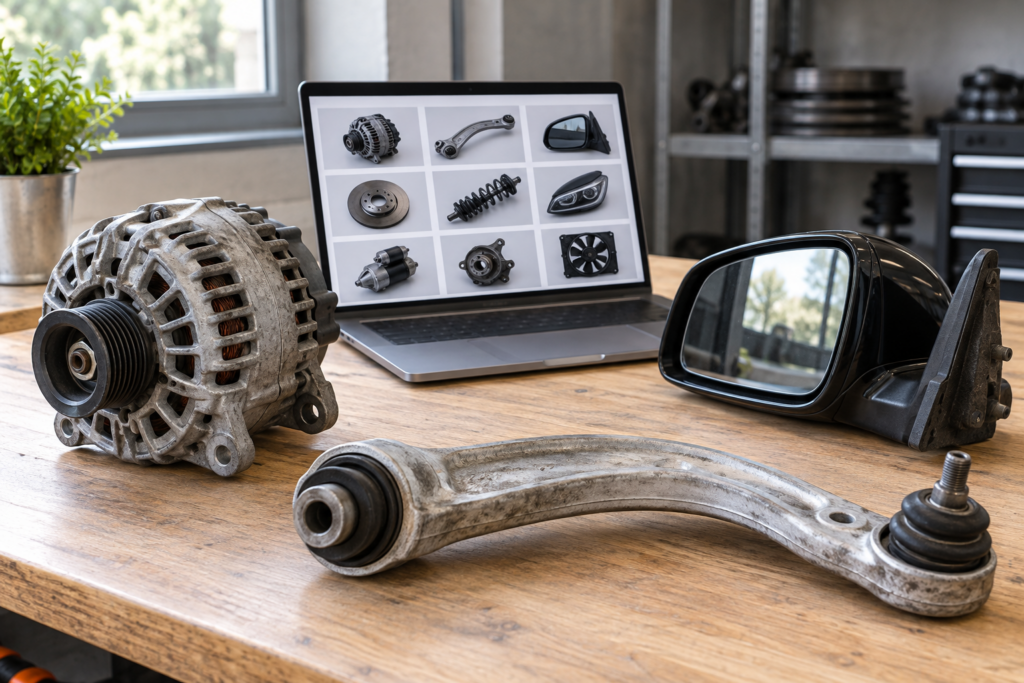
The morning after a slow bump in a supermarket car park, the owner of an F10 528i walks round to the front and finds the right headlight cracked. A dealer quote for a new unit makes the repair feel far bigger than the dent. By lunchtime the same owner has found a factory headlight among bmw used parts and ordered it without leaving the sofa.
That is the everyday case for used bmw parts. Lamps, mirrors, sensors and control modules are factory items that often outlive the car they were first fitted to, and a secondhand original keeps the correct fit, connectors and wiring. On a ten-year-old car, the saving can decide whether a repair happens at all.
This guide stays with BMW and with shopping from home. It covers how prices vary across the model range, how to narrow a catalog of more than two hundred listings to your exact car, and what to check before you pay.
Why drivers choose BMW used parts
BMW builds cars with a long service life and a great deal of electronics, and both push owners towards bmw used parts. An E46 or E39 can still drive well after two decades, yet the modules that run its mirrors, sound system or steering sensors are expensive to buy new. A tested original solves the problem for much less and keeps the car as the factory designed it.
The California Auto Store BMW collection is built around that kind of owner. Its own description names the classic E30, the dependable X5 and the high-revving M3, and it spans engine components, braking systems, M-Performance upgrades and interior accessories. Every listing on the first page is marked OEM, which matters when the job is a like-for-like replacement.
A used factory part makes most sense in three situations. Accident repair on a car that is otherwise sound comes first, since a cracked headlight or broken door mirror is a bolt-on job and an original unit matches the undamaged side exactly. Electronic faults on older models come next, and there a used keyless entry, mirror or steering angle module is often the most affordable way to cure the problem. Owners keeping an aging E46 M3 or early X5 as it left the factory also rely on original parts that fit without modification.
Used parts also suit owners who do their own work, because a lower price on the part leaves budget for gaskets, fluids or an hour of a specialist’s time. Wear items such as brake pads and discs are a different matter, and most owners still buy those new.
What BMW used parts for sale cost across the series
The BMW collection holds more than two hundred products, and a price filter lets you set your own minimum and maximum. Browsing bmw used parts for sale by price first gives a quick sense of scale. Nothing in the collection approaches the cost of a complete engine or gearbox, because the listings are individual components such as lamps, modules, sensors and engine internals.
A sample from the first page shows how prices vary by part type and model:
- Front right headlight for the F10 528i, 535i and 550i built from 2011 to 2013, one of the dearer items in the collection.
- N54 turbo cylinder head valve cover 11127565284 for the E93 335i and 535xi, a useful find when the old cover has started to leak oil.
- Oil filter housing assembly 11421713838, listed for E46, Z3 and X5 models from 1999 to 2006, so one part number serves several body styles.
- Keyless Go entry control module 61359367374 for the F10 528i and 550i, a small electronic unit that is far cheaper used than new.
- Harman Kardon premium audio amplifier for the E46 M3. It restores the original sound system instead of forcing an aftermarket upgrade.
- Oxygen sensor for the E90 and E93 328i, close to the bottom of the price range and a common fix for a warning light.
Prices move as stock sells and new parts arrive, so check the current price on each listing before you plan a repair budget. The pattern is still clear. In this sample, part type drives the cost more than the model or its age.
How to search used BMW parts online
Searching for used bmw parts online is fastest when you narrow the catalog before you browse. Filters cover year, make, model and price, and the model list alone runs to about two hundred entries, starting with the 1 Series M, 118i and 120i. Picking your exact model, such as 528i and not simply the 5 Series, removes most parts that would never fit.
Sorting helps once the list is short. Results can be ordered by relevance, by price in either direction, by customer rating or by newest first. Newest first suits anyone waiting for a rare part to appear, while low to high makes it easy to compare two similar parts.
Part numbers are the next safeguard. Many titles include the eleven-digit BMW number, such as 61356904255 for the E39 door mirror control module, and the store publishes a guide called “How to Find Your Part Number.” If the code on your old part matches the title, the fit question is largely settled.
Quick View opens a listing’s details without leaving the results, and Add to Wishlist keeps a shortlist if you are comparing parts over a few evenings. Once a part looks right, check four details:
- The model years in the title, since a part listed for 2007 to 2011 may differ from the version fitted to later cars of the same series.
- Which side of the car the part belongs to, because headlights and door mirrors are sold separately for left and right.
- The engine code where it appears, such as N54 on the E93 335i or M57 on the diesel X5, as engine parts rarely carry over between petrol and diesel versions.
- The part number stamped on your original component, compared digit by digit with the number in the listing title.
Getting support when you order BMW used parts online
Some questions cannot be answered by a photo. Before you order bmw used parts online, ask whether an electronic module needs coding to your car after fitting, which is common with keyless entry and other control units. Your garage can usually confirm this in a few minutes.
The store’s help section covers shipping, returns, how to order, how to track a parcel and how to find your part number. Read the returns page before you buy, because it is the one that matters if a part turns out to be for the wrong side or year.
If a listing leaves you unsure, contact the support team with your car’s model, build year and the number from the old part. Those three details give them far more to work with than a description of the fault.
Before you start searching, write down the model, build year and engine, photograph the old part with its label visible, and note which side of the car it came from. With that information, the filters, the sorting and the part number do most of the work, and the right component can be in your cart within minutes.