
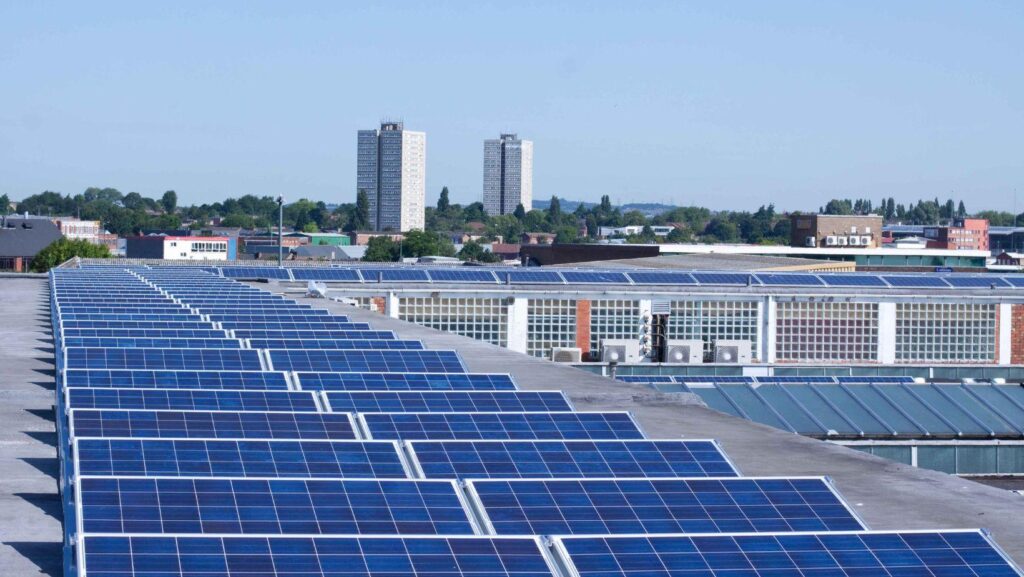
A utility-scale array usually comes down faster than the owner expects it to. The crews are booked, the racking gets cut loose, and within roughly ten working days there are eleven thousand modules stacked on a laydown yard with no buyer identified, no freight plan in place, and a site handover date that has not moved at all. That is normally the point at which somebody in the organization starts searching for companies that buy panels in bulk, and by that stage most of the seller’s negotiating room is already gone.
The default outcome for this material is well documented. Yale Environment 360 reports that roughly 90 percent of panels in the U.S. that have lost efficiency due to age, or that are defective, end up in landfills. Landfills in that account charge one to two dollars to accept a panel, rising to approximately five dollars if the material is deemed to be hazardous, and recycling costs a good deal more than that. Set against those numbers, a pallet of working modules that could have been sold instead gets tipped for a few dollars, and the reason is usually that nobody sequenced the work in advance.
Selling a decommissioned array in bulk is a sequence of stages, and the order of those stages matters more than the buyer list does. What follows is that sequence, stage by stage, with the buyer categories sitting where they actually belong, which is in the middle, after two decisions that determine what you are able to sell at all.
Stage One: Decide What the Array Is Before You Decide Who Buys It
The first question is not who buys decommissioned panels. The first question is which of three end states each portion of the array is headed for, because each of those end states has a different buyer, a different pricing mechanism, and a different paperwork trail.
Resale, Repurposing, and Recycling Are Three Different End States
Resale means that a module goes back into service producing power for a new owner, and it is sold as used equipment at a price per watt. Repurposing means that the module is redeployed into a lower-stakes application in which a derated output is acceptable, for example, off-grid pumping, telecom sites, agricultural buildings, or export markets that have different grid requirements. Recycling means that the module is destroyed on purpose so that its glass, aluminum frame, silicon, silver, and copper can be recovered as feedstock, and in that case the owner pays for the service rather than receiving a payment for the equipment.
Those three end states are not a ranking of quality. They are three separate markets that happen to accept the same physical object.
The Sort Happens on Site, Not at the Buyer’s Dock
A decommissioned array is very rarely uniform. On a twenty-year-old commercial roof, or on a farm that is being repowered, you will typically find a majority of intact modules still producing within a reasonable band of nameplate output, a minority with visible damage from hail, handling, or delamination, and a scattering of units with failed junction boxes, corroded connectors, or burnt bypass diodes.
Sorting that population into resale, repurpose, and recycle piles before you solicit any offers is probably the highest-value hour of work in the entire project. Buyers will price a graded and described lot. They will discount an unsorted lot, because an unsorted lot transfers the sorting cost and the risk of unpleasant surprises onto the buyer, and the buyer will price that risk generously in his or her own favor.
The practical sort is a visual pass for glass cracks, backsheet tears, frame damage, and burn marks, followed by a sample of electrical checks taken across each production batch that you find on site. You do not need to test every single module. You need enough tested units per model and per string to be able to say something defensible about the population as a whole.
Stage Two: Establish the Waste Status of the Lot Before the First Pallet Moves
This is the stage that most sellers skip over, and it is also the one that can turn a routine equipment sale into a compliance problem several months later.
Under federal rules, a discarded solar panel is regulated waste. The Environmental Protection Agency states plainly that federal solid and hazardous waste regulations apply to solar panels when they are discarded. A panel that is being sold for reuse is generally not a discarded material. A panel that is headed for destruction is a discarded material. The same pallet can therefore sit on either side of that line depending on what was decided back in Stage One, which is the reason that the decision has to come first.
Where a module is being discarded, the generator is required to determine whether it is hazardous. The EPA notes that the most common route to a hazardous determination is the toxicity characteristic, and that heavy metals such as lead and cadmium may be leachable at concentrations that would cause a waste panel to fail the toxicity characteristic leaching procedure, which is usually shortened to TCLP. The agency also points out that the results are not uniform, and that some panels are hazardous while others are not, even within the same model from the same manufacturer. A generator who already knows from previous experience that a given panel will fail the test is permitted to determine without carrying out the testing.
There are two consequences here for anybody selling in bulk.
The first consequence is that the determination is your obligation as the generator of the waste, and it is not the buyer’s obligation. Handing panels to somebody who takes them away does not transfer that responsibility backward in time.
The second consequence is that state rules vary considerably, and several states operate their own universal waste programs for photovoltaic modules, which change the storage, labeling, and transport requirements without changing the underlying federal question. California is the most consequential example for anybody selling out of the western United States. The state to check is the state where the array is physically sitting, and not the state where your head office happens to be registered.
Establishing waste status early also protects the resale value of the lot, because a lot that is documented as reusable equipment moves under commercial terms rather than under waste terms, and that difference shows up in the freight cost, in the insurance, and in the number of buyers who are willing to look at it.
Stage Three: Size the Lot the Way Buyers Size It
Bulk is a fuzzy word in this market, and mismatched expectations about volume are probably the most common reason that a promising conversation with a buyer goes nowhere.
There are three rough tiers that govern who will take your call.
Residential and small commercial volumes, meaning a handful of modules up to a few dozen of them, sit below almost every professional buyer’s floor. This material generally moves through consumer marketplaces, local classified listings, or a homeowner-facing recycling drop-off, and the economics rarely justify the freight cost.
Commercial volumes, meaning approximately one hundred modules up to a few thousand of them, are where the dedicated bulk buyers start to get interested. One hundred panels is the threshold that you will see published most often as a working minimum. That number is not arbitrary. It is roughly the point at which a lot fills enough pallet positions to make a dedicated truck sensible rather than a partial load moving at less-than-truckload rates.
Utility-scale volumes, meaning tens of thousands of modules coming off a repowered or retired farm, are a different transaction again. At that size, you are usually negotiating a whole-site off-take rather than selling a lot, and the buyer’s interest extends to the entire population of equipment, including the inverters, transformers, combiner boxes, racking, and battery storage.
Two definitions are worth stating plainly here, because the market uses both of them fairly loosely. An off-taker is a buyer who commits to take a defined volume of retired equipment from a site, and that commitment typically covers the whole population rather than a selected portion of it. A buyback program is a standing arrangement, usually published by a recycler or by an asset-recovery firm, under which retired equipment is valued, then purchased where it has resale value, and processed where it does not.
Stage Four: Take the Lot to the Right Kind of Buyer
Once you know what you have and how much of it there is, the buyer market sorts itself into five categories. Most sellers are only aware of one or two of them, and that is a large part of the reason that so many arrays end up under-monetized.
Turnkey asset-recovery and recycling firms are the category that handles the whole population of equipment. They buy the units that have resale value, they recycle the units that do not, and they coordinate the freight for both. This is the only category that solves the mixed-condition problem in a single transaction, which is the reason it dominates utility-scale decommissioning work. SOLARCYCLE and Fabtech Solar Solutions are two examples of firms operating in this space in the United States.
Secondary-market brokers and business-to-business exchanges connect sellers to a network of buyers rather than buying the inventory themselves. EnergyBin operates as a members-only exchange for solar equipment, and industrial surplus marketplaces such as Salvex list decommissioned lots to a broad pool of bidders. Brokers can achieve better prices on clean, well-graded modules that are in demand. They are a poor fit for damaged or obsolete stock, and they leave the recycling problem sitting with you.
Manufacturer take-back programs handle modules that were made by the manufacturer running the program. First Solar has operated a recycling program of this kind for its own cadmium telluride modules for several years. If your array carries a single manufacturer’s product, and that manufacturer runs a take-back scheme, then this route can be cost-effective, although it is a disposal path rather than a revenue path.
Materials recyclers and scrap processors buy the array for what it contains rather than for what it does. Their interest is in the glass, aluminum, silver, copper, and silicon. Pricing is driven by commodity markets and by the processor’s own recovery yield, and these firms will generally quote you a net cost rather than a payment, because the recovery value on most panels does not yet cover the cost of processing them. The Department of Energy is direct about this economics problem, and notes that the total cost of recycling is still generally greater than the cost of disposing of panels in a landfill.
Repurposing and export buyers take working but derated modules for secondary applications, or for markets in which price matters more than efficiency per square meter. This channel can be the highest-value home for older and lower-wattage panels that resale buyers in the United States no longer want, because domestic demand skews toward higher wattages and standard form factors. It also carries the most diligence risk, and a seller ought to know where the containers are actually going.
One category deserves a word of caution. If a buyer is willing to take an unsorted and undocumented lot sight unseen at an attractive number, ask what happens to the units that fail inspection at their facility. The answer to that question determines whether you have sold equipment or whether you have simply relocated a waste liability.
Stage Five: How a Bulk Buyback Actually Prices and Pays
This is the stage that sellers understand least well, and the mechanics of it are more specific than the word buyback tends to suggest.
A bulk buyback is not a single price. It is two separate calculations that are netted against each other. The resale portion of the array is valued on a per-watt basis. The non-resale portion is costed on a per-panel basis for recycling and destruction. What lands in your account, or alternatively what you end up paying, is the difference between those two figures.
The per-watt side is where most of the value sits. Published buyer ranges put used modules at roughly $0.05 to $0.60 per watt, as against roughly $0.70 to $1.50 per watt for new equipment. That spread is very wide because it is doing a lot of work, in that it absorbs the module’s age, its remaining warranty, its wattage class, its condition grade, the current demand for that specific form factor, and the distance the pallets have to travel. A four hundred watt module in good condition at the top of that range is worth approximately two hundred and forty dollars. The same module at the bottom of the range is worth approximately twenty dollars. The grading work from Stage One is what moves a lot along that scale.
The per-panel side is the cost of everything that cannot be put back into service. Recycling a non-functional module generally runs at about $20 to $50 per panel, plus the shipping. If you multiply that across a few thousand failed units, the number becomes the dominant term in the whole deal.
The netting is the point of the exercise. On an array with a healthy proportion of working modules, the resale value can offset most or all of the recycling cost for the remainder, which is how a decommissioning event that looked like a five-figure disposal bill ends up closer to a wash. One of the nationwide firms that runs this netted model is https://solarrecycling.com, which buys used panels, inverters, and battery storage from commercial and utility-scale sites, and recycles the equipment that cannot be given a second life. Operators who want to sell used solar panels in commercial volumes normally work through a short intake sequence with buyers of this type: submit the specifications and the photographs, receive an initial estimate, and then dispatch the pallets, with a typical minimum of one hundred panels and with quotes commonly turned around within twenty-four hours. Where a lot has to be processed rather than resold, the same firms run a longer chain of steps, which is discovery, then estimation, then logistics, then reprocessing, and finally a certification step that documents what was recovered.
What the buyer needs from you to price the lot accurately is fairly short and quite specific.
The make, model, and nameplate wattage for every distinct batch on the site. A count by batch. Condition grades taken from the sort in Stage One, with photographs of representative units and of anything that is damaged. The physical location, including whether a truck can get to the panels or whether they are sitting on a roof behind a stair core. The date by which the site has to be clear. And whether the inverters, combiners, racking, or batteries are part of the package, because a buyer who takes the balance of system will usually price the modules better.
Sellers who supply that package tend to get firm offers. Sellers who send a photograph of one pallet and ask what it is worth tend to get a conservative number, because the buyer is pricing the unknowns.
Stage Six: Freight Is the Line Item That Decides the Deal
Solar modules are an awkward freight class. They are heavy, they are fragile, they are large, and they are low in value density, and that combination punishes casual planning.
Palletizing determines nearly everything downstream of it. Modules are stacked vertically on edge rather than laid down flat, they are separated by cardboard or foam, and they are banded, corner-protected, and stretch-wrapped. A standard pallet takes approximately twenty-six to thirty full-size modules depending on the frame depth. Twenty-six pallets fit into a fifty-three-foot dry van, which puts a full truckload at somewhere around seven hundred modules. Those numbers explain why buyer minimums cluster where they do, and why a lot of one hundred and ten panels gets priced differently from a lot of seven hundred panels.
Damage in transit is the largest avoidable loss in the entire process. A module that arrives cracked is a recycling cost rather than a sale, and the swing between those two outcomes is effectively the whole margin. Sellers who have done this before tend to over-specify the packaging rather than saving a few dollars per pallet on materials.
On-site pickup is the norm for utility-scale lots, and it is worth asking about explicitly. A buyer who sends their own crew and equipment out to a solar farm removes both the labor and the packaging risk from your side of the ledger, although the cost of doing that is priced into the offer one way or another.
Two logistics details are commonly missed. The first is that if the lot has been determined to be hazardous, the transport requirements change and not every carrier is able to move it. The second is that the storage between decommissioning and shipment needs to be dry and secure, because modules that are left out in a field for a season will arrive in worse condition than they left in, and the buyer will re-grade them on arrival.
Stage Seven: Close the Paper Trail
The transaction is not finished when the truck leaves the site. For a commercial or utility asset owner, it is finished when the documentation has been filed.
The records worth insisting on are a bill of sale or a transfer document for the portion that was resold, a weight or count reconciliation for what was received against what was shipped, evidence of downstream processing for the portion that was recycled, and a completion certificate or recovery report that states what was recovered and how the balance was handled. Firms that process at scale issue that certificate as a matter of course, and it is a reasonable thing to ask about before you commit to anything.
That paperwork matters for three reasons that have very little to do with tidiness. It closes out the generator obligation described in Stage Two. It supplies the evidence behind any landfill-diversion or sustainability reporting that the asset owner has committed to. And it is the first thing an insurer, a lender, or an acquiring party will ask for if the site changes hands at a later date.
Keep it with the decommissioning file, and not in an email thread.
What Changes If You Start Six Months Earlier
Almost every problem described above is really a scheduling problem in technical clothing. The grading is easy while the array is still up on the racking and the crew is still on the site. The waste determination is easy before the panels have been stacked in a yard. The buyer conversation is productive when there is enough time to run a competitive process, and it is not productive when the site has to be clear by Friday.
The Department of Energy’s assessment of cumulative photovoltaic waste in the United States puts it at somewhere between 0.17 and 1 million tons by 2030, and a range that wide tells you that the industry does not yet know how much of this material will be handled well. That number will not be settled by policy. It will be settled by thousands of individual decisions about arrays coming down over the next decade, and those decisions get made either six months in advance or on the Thursday before the handover.
Renewable generation is judged on the whole lifecycle, and the last stage of that lifecycle is currently the weakest part of it. The owners who treat decommissioning as a sequence of stages rather than as an emergency are the ones who recover real value out of it.