
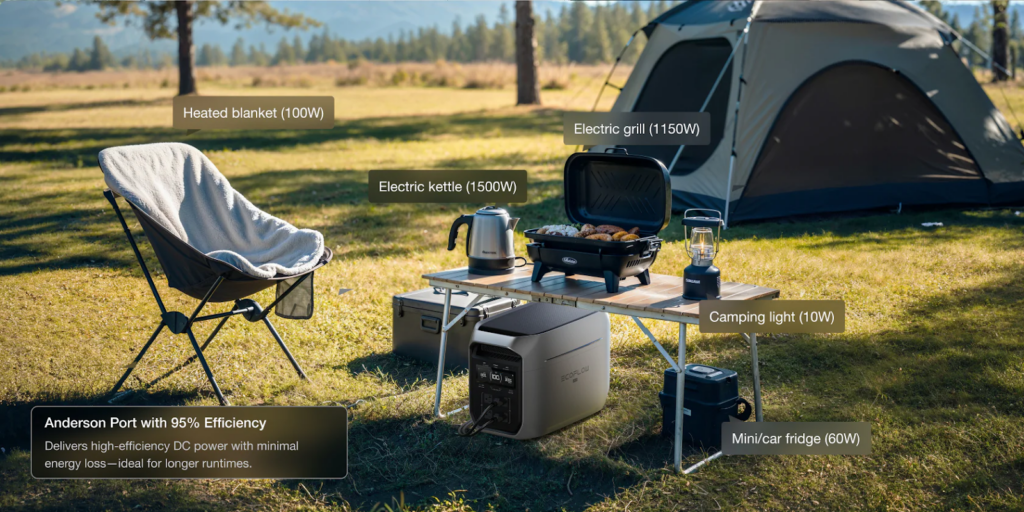
Whether it is a short weekend trip or a long cross-province journey, power supply is one of the most critical aspects of RV travel. This guide starts from real electricity needs and systematically explains the mainstream power solutions available today, helping you build a reliable mobile power system with the right portable power station and charging setup.
1. How Much Electricity Does RV Travel Actually Require?
Before choosing a power solution, the first step is to calculate your electricity demand. Many travelers discover that their system is not sufficient only after purchasing equipment. The issue usually comes from not calculating power and capacity in advance.
Common Device Power Reference
| Device | Power (W) | Daily Usage (h) | Daily Consumption (Wh) |
| LED lighting | 10–20 | 5 | 50–100 |
| Phone charging | 15–25 | 2 | 30–50 |
| Laptop | 50–80 | 4 | 200–320 |
| Car refrigerator | 40–60 | 24 | 960–1440 |
| Rice cooker | 500–800 | 0.5 | 250–400 |
| Electric kettle | 1000–1500 | 0.2 | 200–300 |
| Portable air conditioner | 600–1200 | 6 | 3600–7200 |
| Electric heater | 800–2000 | 4 | 3200–8000 |
How to Estimate Total Demand
Daily energy consumption = Sum of (device power × usage time)
Example of a typical two-person RV travel day:
Lighting, phones, laptop approximately 400Wh
Refrigerator running all day approximately 1000Wh
Cooking one meal approximately 500Wh
Total approximately 1900Wh per day
If air conditioning or heating is required, daily consumption can exceed 5000Wh.
As a practical rule, choose a battery capacity that is 1.2 to 1.5 times your estimated daily consumption to account for conversion losses and to avoid fully discharging the battery.
2. Comparison of Mainstream Power Solutions
Option 1: Fuel Generator
Principle: Generates electricity by burning gasoline or LPG to drive an engine.
Advantages:
High output power, typically 1000W to 5000W or more
Not dependent on weather
Suitable for high-power appliances
Disadvantages:
High noise level, typically 60–90dB
Requires continuous fuel supply
Produces carbon monoxide and other harmful gases
Regular maintenance required
Suitable for travelers with very high power needs who do not mind noise or fuel consumption.
Option 2: Portable Power Stations
Principle: Built-in large rechargeable battery, usually lithium, providing AC and DC output after being charged.
Advantages:
Silent operation
No emissions
Safe for indoor use
Plug and play
Multiple charging options such as AC, solar, and vehicle charging
Disadvantages:
Limited capacity
High-power devices may not run for long
Large capacity models can be expensive
Suitable for most RV travelers who value quiet, safety, and convenience.
Option 3: Solar Power System
Principle: Solar panels convert sunlight into electricity to charge batteries or power devices.
Advantages:
Renewable energy
No noise
Low operating cost
Disadvantages:
Strongly weather dependent
Requires sufficient installation space
Cannot independently support very high power demand
Best used as a supplementary charging solution alongside a battery system.
Option 4: Vehicle Alternator Charging
Principle: Uses the vehicle’s alternator while driving to charge auxiliary batteries or portable power stations.
Advantages:
Charges while driving
No additional fuel cost
Relatively low equipment cost
Disadvantages:
Only charges during driving
Charging speed depends on alternator output
Professional installation required
Suitable as a supplementary charging method for travelers who drive daily.
Quick Comparison Overview
| Criteria | Fuel Generator | Portable Power Station | Solar | Alternator Charging |
| Output Power | High | Medium to High | Low | Medium |
| Noise | High | Silent | Silent | Silent |
| Emissions | Yes | No | No | No additional |
| Indoor Safety | Not allowed | Safe | Safe | Safe |
| Weather Dependence | None | None | High | None |
| Maintenance | High | Low | Low | Low |
| Portability | Heavy | Portable | Medium | Fixed |
| Continuous Supply | Fuel dependent | Capacity dependent | Weather dependent | Driving dependent |
3. The Most Practical Approach: Combination Systems
No single solution perfectly covers all RV travel needs. The most practical strategy is combining systems based on your travel style.
Combination 1: Power Station plus Solar Panels
Suitable for short and medium trips.
Charge fully at home
Use solar panels for daytime charging
Use battery for nighttime supply
Recommended capacity for two people: 1000–2000Wh
Recommended solar input: 200–400W
Combination 2: Power Station plus Vehicle Charging
Suitable for long-distance travelers who drive several hours daily.
Charge while driving
Use battery when parked
Recommended to prioritize systems supporting high vehicle charging input.
Combination 3: Power Station plus Solar plus Generator
Suitable for remote travel and extreme conditions.
Solar as main daytime source
Battery for silent nighttime use
Generator for emergency backup
Battery Capacity
Determines how long the system can run.
| Capacity | Suitable Scenario |
| 300–500Wh | Light use |
| 500–1000Wh | Weekend trips |
| 1000–2000Wh | Refrigerator and cooking |
| 2000–4000Wh | High-power appliances |
| 4000Wh+ | Long-term off-grid |
Rated Output Power
Determines which appliances can run simultaneously.
An 800W system can operate a coffee maker but not a 2000W induction cooker.
A 3000W system can power most household appliances.
Battery Type
| Type | Cycle Life | Safety | Weight |
| NCM Lithium | 800–1200 cycles | Moderate | Lighter |
| LFP Lithium | 3000–5000 cycles | High | Slightly heavier |
LFP batteries offer longer lifespan and higher safety for long-term RV use.
Charging Methods
Ideal systems support:
AC charging
Solar charging
Vehicle charging
Generator charging
EV charging when compatible
Output Ports
Ensure sufficient:
AC outlets
USB ports
12V car socket
DC outputs
Expandability
Some systems allow additional expansion batteries to increase total capacity without replacing the main unit.
5. Practical Tips to Extend Battery Runtime
Use LED lighting
Pre-cool the refrigerator before departure
Avoid frequent high-power startups
Use driving time for high-power tasks
Adjust solar panel angle for maximum exposure
Turn off unnecessary devices at night
6. Frequently Asked Questions
Can a portable power station be used inside a vehicle?
Yes. Lithium battery systems produce no harmful gases under normal operation.
Can solar panels charge on cloudy days?
Yes, but output drops to approximately 10 to 30 percent of normal levels.
Can a power station function as a UPS?
Depends on switching time. Systems with under 10ms switching are suitable for sensitive electronics.
Does cold weather affect battery performance?
Yes. Below 0°C, charging efficiency decreases. Keep the unit insulated and avoid long-term storage at full or empty charge.
What if one unit is not enough?
Consider expansion batteries, solar charging, or operating two units alternately.
Conclusion
There is no single correct solution for RV travel power systems. The best approach depends on travel style, energy demand, and budget.
Short trips for two people: 1000–2000Wh power station plus portable solar
Long-distance travel: 2000Wh+ plus vehicle charging and solar
Long-term off-grid: 4000Wh+ plus high-power solar and generator backup
Minimalist travel: 300–500Wh plus vehicle charging
A portable LFP battery power station combined with solar and vehicle charging currently provides the most balanced solution in terms of safety, convenience, and overall performance.