
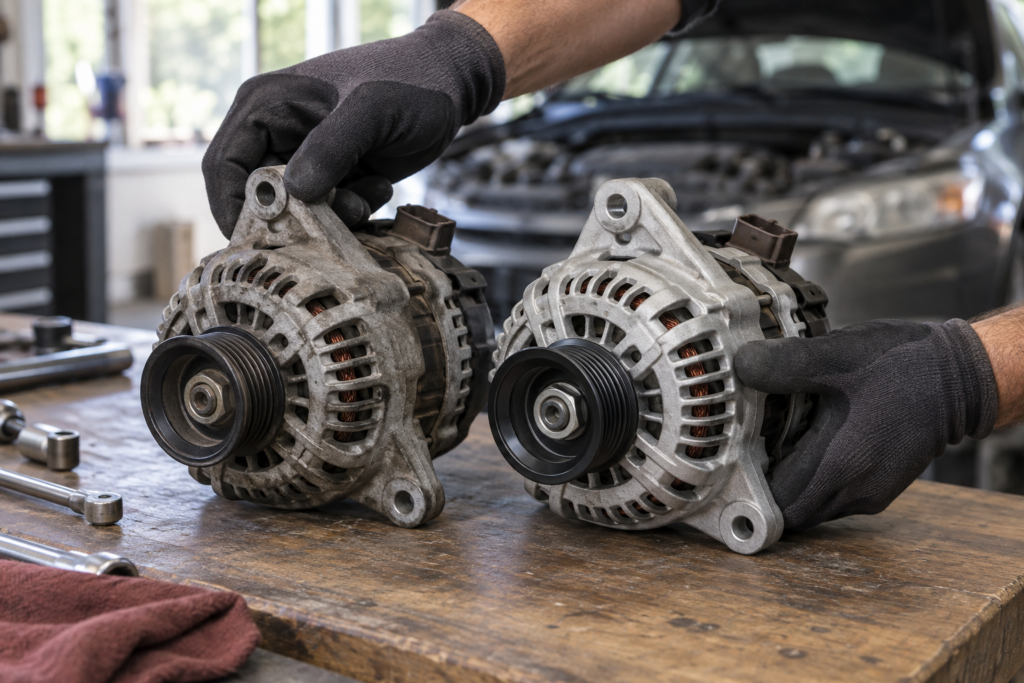
A Toyota owner is staring at a mechanic’s estimate for a new mass air flow sensor. Searching the code printed on the old unit, 22204-22010, they find a factory sensor with that exact code among oem used parts listed for Toyota, Porsche and other makes. So here’s the fair question. Is a part that’s already spent years on somebody else’s car a smart way to save, or just a gamble?
If you drive an older car, the word “used” matters less than you’d think. Two other things matter more. Was the part made by the original manufacturer for your exact model? And can you prove it fits before the money leaves your account? You can check both at home. All it takes is the old part, your car’s details and a bit of patience.
What makes OEM used parts different from aftermarket copies
OEM means original equipment manufacturer. It’s the part the carmaker put in at the factory, or sold under its own part number, so its size, connectors and electrical behavior match the car it was made for. Aftermarket copies come from a third party. They’re built to imitate that part. Sometimes the copy is very close; sometimes it’s pretty loose.
You’ll notice the difference most in parts that talk to other systems. Take a mass air flow sensor. The engine computer is calibrated to trust its readings, and a copy that responds even slightly off can leave the engine running rich or throwing fault codes nobody can trace. Trim and brackets are more forgiving. Still, one clip in the wrong spot can mean a panel that rattles for years.
Buying OEM used parts means living with some wear. That’s the honest trade-off. In return you keep the original design, material and fit, and if the donor car was looked after, the wear is often pretty modest.
So why pick a factory part that’s already seen service over a brand-new copy? A few reasons:
- The part number matches the carmaker’s catalog. You can check it against your old part or a dealer lookup.
- Connectors, mounting points and hose ends are shaped for your model, so you won’t be drilling, trimming or hunting for adapters the way you sometimes are with copies.
- Sensors and electronic modules respond the way the engine or body computer expects. That means less chance of warning lights once it’s in.
- Materials follow the original spec. A factory hose or trim panel was built for the heat and vibration of that exact spot.
Where used OEM parts save you the most
You save the most where a new factory part costs a lot and the used one wears slowly. Think castings, housings, control modules and interior pieces.
Engine hardware is a good example. A new driver-side cylinder head for the 1996 to 2004 Tacoma and 4Runner with the 3.4 L 5VZ V6 isn’t cheap. A used head off a healthy engine, though, can be inspected, pressure-tested and machined by your shop before it goes on. Same logic for an ABS hydraulic pump module for the 1990 to 1995 Toyota Pickup and T100. Its factory number is 44510-35020.
Older and low-volume vehicles gain the most. Once a model’s been out of production for years, dealers stop stocking its parts. Try finding a new ABS module for an early-nineties truck. You’ll quickly see why used OEM parts are often the only factory option left.
Porsche owners have a different headache: new factory prices run high even on small stuff. A glove box compartment for the 2010 to 2016 Panamera turns up second-hand. So does engine oil hose 94810703001, shared by the 4.8 L V8 Cayenne and Panamera. Interior or engine, these pieces still carry their original numbers.
Some things you should just buy new, whatever the price gap. Airbags, and anything with a single-use charge, need to come from a known source. Brake pads, filters and drive belts? They wear too predictably to be worth buying used.
How to match used OEM auto parts to your vehicle
Fit is where most second-hand buys go wrong. Usually the buyer matched the model name and skipped the rest. Model years overlap. Engines change mid-generation. And a part that looks identical in a photo can be off by a single connector pin. Matching used OEM auto parts the right way takes a few minutes, and it saves you a return.
On the store’s homepage there’s a vehicle finder. It asks for the year, then the make, then the model, and once you’ve picked all three it shows the parts that fit. Use it as a first filter. Then confirm the details yourself.
Before you order, go through these checks in this order:
- Read the part number stamped or printed on the old part. It’s the most reliable identifier you’ve got, and it should match the listing exactly.
- Compare the listing’s year range and engine code with your car, for example 3.4 L 5VZ. One model can come with several engines.
- Look for part codes shared across brands. The MAF sensor 22204-22010 is listed for Toyota, Lexus, Scion and Mazda, so your search just got wider.
- Note the side and position, like front right or rear left. Mirrors, window regulators and seat parts rarely swap from one to another.
- Old part missing, or its label worn past reading? Ask your mechanic to check the number against a dealer lookup.
Sellers who list OEM used auto parts with full numbers and year ranges make all this quick. If a listing only gives a vague description, ask for a photo of the label before you pay.
Warranty and payment checks before you buy
Even the right part can fail. And a used one has a history you can’t see. That’s why the terms of the sale matter almost as much as the part itself.
This store gives a 90-day warranty on its parts. That’s enough time to fit the part and drive long enough to spot a fault. So don’t let it sit in the garage. Put it on soon after delivery, while the coverage still applies.
For payment, the store takes Visa, American Express, PayPal, Payoneer, Mastercard and Discover. Pay by card or PayPal and you get some buyer protection on top of the seller’s own terms. On any second-hand purchase, that’s worth having.
When the box shows up, don’t grab the tools yet. First compare the code on the part with the listing and with your old part. Look for bent pins on the connectors and cracks in the housings. Hose ends shouldn’t be hard. See anything doubtful? Photograph it that same day, because a claim goes much easier with pictures taken on delivery.
Want to weigh up an offer? Get the old part or a clear photo of its label, your car’s year, engine and trim, and the mechanic’s quote for a new part. Now you’re comparing like with like, and you can decide if the saving justifies the wear. For a sensor, a module or a casting on an older car, OEM used auto parts from a clearly documented listing are usually the smart call.